Classroom Design: Use it to Cue the Behavior You Want to See
Emily Beal Wilkinson, M.S., BCBA, LBA
October 11, 2026
We’ve all been there: it’s August, you’re trying to figure out how to best set up your SPED room to support a wide range of learners. You know the skills you want to teach them—and chief among those skills are adaptive, life skills to help them achieve the most independent life possible. But then, all you can think about are task bins and the shelves upon shelves needed to store those bins. So you trek to Ikea, buy them out, and voila…your room now looks like a Tupperware commercial.
We want our students to learn how to live, but we end up building them storage units instead of living rooms. Complete with individual desks so there is nowhere to practice life as a group. So what do we do?
Task Bins and the Limits of Rote Instruction
When Kristina Montgomery and I first began our journey with Essential for Living as a curriculum, we knew we were supposed to teach in-context. But this was so new to us that we also defaulted to these same strategies: think of every possible vocational skill you could ever teach and throw that stimuli in a clear box and put it on a shelf for a visual schedule later. And there’s nothing wrong with that, per se. But our data showed that our students weren’t understanding the purpose behind the task—so it became meaningless, and therefore frustrating to them—and they were struggling to generalize many of those skills into the real contexts in which they’d need them.
We did the stations, with the bins, and the schedules. And as much as we were trying to create living, breathing instruction, even that became rote, and the students relied too heavily on our prompts.
How the Environment Cues Behavior
Kristina and I brainstormed and evolved over years and one of my favorite analogies she uses for a shift toward a more naturally set up environment is that of buffets. We all know how to behave at a buffet. You put your stuff down in a booth, get in line, grab your plate, load it up, get utensils and sit down. And not a single person has to tell you all of those steps. The environment cues the behavior.
Our classrooms should function much the same way. Shelves of plastic bins can be trained as a cue, but the question has to be asked, “Is that setting our students up for their life outside of the classroom?” Homes, libraries, workplaces, and most other community stops aren’t set up that way. So are we actually helping them when we set up our rooms so drastically different from the rest of their lives?
Designing Classrooms Around Real Life
After a pilot year with our own bins, rotations, and carefully controlled environment, we knew we had to shift toward something very divergent but potentially far more effective. We surveyed families and asked them what their dream would be for a quiet 30 minutes. We often ask parents if they’re able to get a half hour alone, with coffee, or a glass of wine, while their child preoccupies themselves. The answer is almost always a grief-stricken “no.” So, we asked what shows they’d like to watch that their children didn’t currently tolerate, or what shows they’d like their children to watch so they could watch together—The British Baking Show came up far more often than you’d think!
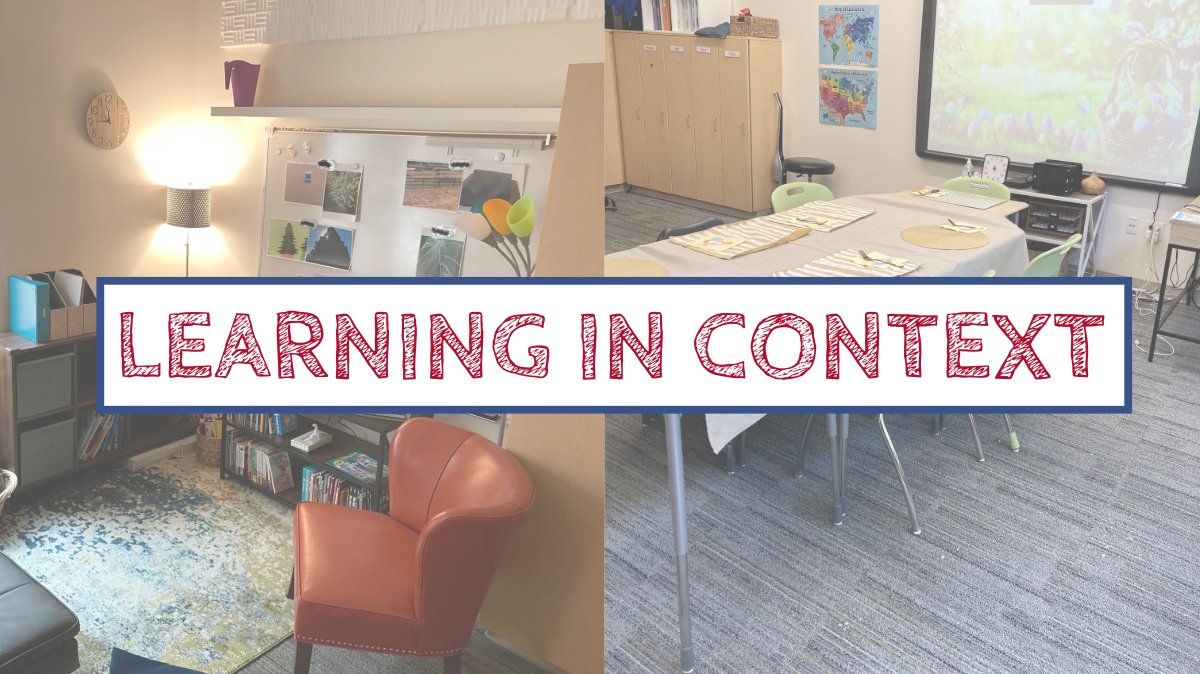
And our evolution was born. We set up areas of the room that mimicked real life spaced they’d need the skills we were desperately trying to teach them. We set up a little corner as a living room, with a couch and a TV (or a projector for safety in some rooms), and magazines and books so that learners learned how to appropriate use furniture (also a common struggle when we poll parents) and sit and attend to what the families themselves listed as priorities, hopes and dreams.
What Families Saw at Home
And it worked. For some, the shaping of these areas took months and months; for others, they were a much quicker study. But parents began to report back that they could stream the news in the morning and their child didn’t engage in challenging behavior, or that they could sit down and watch a cooking show with their student and they were able to sit the entire time! These were life changing skills we taught by embracing a more natural environment and letting go of everything we’d been taught about skill acquisition in SPED.
Natural Classroom Environments and Student Anxiety
There is an emerging body of research on therapeutic classrooms that are finding that when classes are set up with more real stimuli, softer fabrics, kinder lighting, and plants, that students report less anxiety in their school environment. That research has yet to fully catch up with SPED rooms, but they confirm something we all have experienced: when you walk into a space that is natural, lovely, and that makes sense, you know what to do. We saw this grounding first hand at our own shift from desks and controlled station spaces to real life sections of the room. Our students went from wandering without purpose until prompted to understanding exactly what they were supposed to do. And their parents saw it too. Who wouldn’t want to have a misty-eyed mom pull you aside to say, “Thank you. That’s the first time I’ve ever been able to watch a show I chose with my kids without anyone throwing a tantrum?”
Take Learning Beyond the Classroom with Event-Based Teaching
Designing classrooms around real-life experiences is an important first step. But what happens when we begin designing instruction around those experiences, too?
Event-Based Teaching (EBT) builds on this idea by embedding meaningful instruction into everyday activities and routines. Rather than teaching skills in isolation and hoping they generalize, EBT helps educators and practitioners create opportunities for learners to acquire and practice functional skills in the contexts where they'll actually use them.
Our Event-Based Teaching online course explores how to design meaningful instructional events, embed teaching opportunities, and measure progress in ways that reflect participation, independence, and improved quality of life.
Get the EFL Curriculum
Browse the complete Essential for Living collection — books, bundles, and digital resources for ABA professionals and educators.
Want to Learn More?
Insights, updates, and resources for ABA professionals, educators, and parents.